

Stopping Distances – A Vital Part of Safe Driving
Stopping distance refers to the total distance a vehicle travels from the moment a driver identifies a hazard to the point where the vehicle comes to a complete stop. It’s a critical concept in road safety and is made up of two main components: thinking distance and braking distance.
- Thinking distance is the distance covered while the driver reacts to a situation. This begins when the hazard is spotted and ends when the brakes are applied. It’s influenced by the driver’s reaction time, which can be affected by fatigue, alcohol, distractions, and speed. For example, at 30 mph, the average thinking distance is around 9 metres.
- Braking distance is the distance the vehicle travels after the brakes are applied until it stops completely. This depends on factors such as road surface, tyre condition, weather, brake efficiency, and vehicle weight. At 30 mph, braking distance is typically 14 metres on a dry road.
Together, these make up the total stopping distance. At 30 mph, the combined stopping distance is approximately 23 metres. However, stopping distances increase significantly with speed. At 70 mph, the total stopping distance can exceed 96 metres.
Download our stopping distance pdf
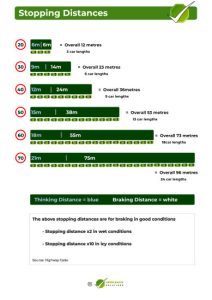
Weather and road conditions play a major role. Wet or icy roads can double or even triple braking distances. That’s why it’s essential to adjust your speed and increase following distance in poor conditions.
The UK Highway Code provides a standard chart of stopping distances for different speeds, which learner drivers are often required to memorise. These figures are based on ideal conditions and should be treated as minimums.
Maintaining a safe following distance is crucial. The general rule is the two-second gap in dry conditions, and at least four seconds in wet weather. This gives enough time to react and stop safely if the vehicle ahead brakes suddenly.
Understanding and respecting stopping distances helps prevent rear-end collisions, improves road awareness, and contributes to safer driving habits. Whether you’re teaching learners or refreshing your own knowledge, keeping stopping distances in mind is a simple yet powerful way to stay safe on the road.